In this post
Get the latest insights delivered to your inbox
Artificial intelligence is no longer just a buzzword for big tech companies. It is quietly reshaping local trades—and pool service is one of the industries feeling that shift the most.
AI‑driven tools now help predict issues before they become emergencies, route technicians more efficiently, and automate time‑consuming office tasks that used to eat up evenings and weekends.
For pool businesses, this is not about replacing technicians. It is about giving owners, office staff, and techs smarter tools so they can do more with less stress, fewer mistakes, and better margins. Pool Office Manager sits right at this intersection: while it is not a sci‑fi robot, it builds the digital foundation where AI‑style automation, smarter recommendations, and data‑driven decisions actually become possible for a pool company.
What “AI” Really Means for Pool Service
In many pool companies, “AI” shows up in three practical ways:
- Pattern recognition: Software detects trends in schedules, service histories, and water chemistry that humans might miss.
- Automation: Routine decisions—like who should take which stop or when to send reminders—are handled automatically based on rules and data.
- Recommendations: Systems suggest next best actions (such as route changes, upsell opportunities, or likely problem pools) so humans can decide faster and with more confidence.
Instead of being a mysterious black box, AI in pool service feels like a super‑organized, tireless assistant: always watching your data, always nudging you toward better choices. A platform like Pool Office Manager provides that assistant with fuel—clean, structured information from the field and the office.
AI and Smarter Pool Maintenance
The first place AI helps is in actual pool care: keeping water balanced, equipment running, and problems away from your customers’ eyes.
Turning readings into real insight
When techs manually test water and jot down numbers, the data often disappears into a notebook or gets thrown away. A digital system changes that:
- Every reading—chlorine, pH, alkalinity, calcium—is logged in a structured way.
- The system can flag unusual patterns, such as persistent pH drift or chlorine demand spikes.
- Historical data helps distinguish one‑off issues from chronic problems that need equipment or strategy changes.
AI‑style analysis on top of this data can:
- Highlight pools likely to go cloudy or algae‑prone before it happens.
- Suggest when to recommend filter cleanings, equipment upgrades, or changes in treatment strategy.
- Identify high‑risk pools on each route so techs give them extra attention.
Pool Office Manager supports the necessary foundation—consistent digital logging and easy access to history—so these kinds of insights are possible instead of relying on memory.
Reducing chemical waste and improving sustainability
With better data and pattern recognition, AI can help:
- Avoid over‑dosing by recommending precise adjustments based on past behavior.
- Suggest when a series of small corrections is more effective than a single large shock.
- Identify pools that consistently need extra chemicals and may be candidates for upgrades (better circulation, salt systems, automation).
For a pool business, that means lower chemical costs, fewer callbacks, and a more sustainable operation—benefits that are only unlocked when techs use software like POM to capture every visit accurately.
AI‑Driven Route Optimization and Scheduling
The second major area AI is transforming is scheduling and routing—the heartbeat of any pool company.
From “best guess” to data‑driven routing
Traditional routing is often based on:
- Rough area groupings (“All the east‑side stops go to this truck”).
- Tech familiarity (“Sam always does this neighborhood”).
- Habit (“We’ve always done it that way”).
AI‑assisted routing instead looks at:
- Actual travel times and traffic patterns.
- Service duration history for each stop (some pools always take 10 minutes longer).
- Seasonal patterns, like heavier loads in spring or specific days.
A system like Pool Office Manager:
- Holds all the route and service history data in one place.
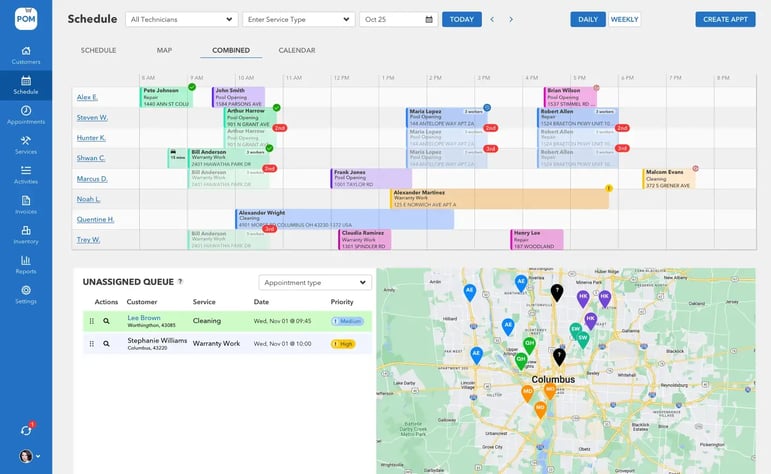
- Shows a map and calendar view so humans can quickly accept or refine optimized routes.
- Makes mid‑day adjustments easy—dragging a few stops from one tech to another and updating mobile apps instantly.
As AI‑style algorithms mature, they can propose routes that maximize stops per day while minimizing drive time and overtime, turning your existing team into a much more efficient operation.
Balancing workloads and preventing burnout
Because AI can analyze past days and weeks, it can also:
- Flag days where a route is consistently overloaded.
- Suggest redistributing heavy, complex pools across multiple days or techs.
- Predict when more capacity (extra tech or truck) will be needed based on demand trends.
Owners using POM as their core platform can see these patterns early and decide whether to adjust schedules, tweak pricing, or increase staffing—before techs burn out or service quality drops.
AI in Customer Communication and Reputation Management
Your reputation increasingly depends on how you communicate, not just how you clean. AI‑driven tools help keep customers informed and feeling cared for.
Automated, intelligent messaging
Instead of manual reminders and follow‑ups, an AI‑supported system can:
- Automatically send appointment reminders before openings, closings, and one‑off jobs.
- Trigger follow‑ups after major work or green‑to‑clean projects asking if everything looks good.
- Time review requests after positive service moments, increasing 5‑star review volume.
Pool Office Manager already centralizes customer contacts, service records, and schedules, making it much easier to layer in smart messaging rules that feel personal but run automatically.
Smarter issue resolution
When something does go wrong, AI‑friendly systems help you:
- Instantly pull up the full service history, readings, and photos for that pool.
- See patterns in similar complaints across routes or techs.
- Suggest likely root causes based on past data and known issues.
This lets you respond faster and more accurately, turning potential reputation hits into opportunities to demonstrate professionalism. The key is that POM holds the facts in one place, ready to power those quick decisions.
AI and Office Productivity: Freeing Time to Grow
AI will not just help in the field; it will profoundly change office work as well.
Automating repetitive admin
Tasks that are ripe for AI‑style automation include:
- Building and adjusting schedules based on rules and constraints.
- Turning completed jobs into invoices and pushing them to accounting.
- Categorizing customer messages and routing them to the right person or priority level.
Pool Office Manager already reduces manual work by linking jobs and billing; AI enhancements on top of that can:
- Flag suspicious billing anomalies before they go out.
- Suggest adjustments based on service history (for example, catching underpriced accounts).
- Predict cash‑flow dips and peaks based on seasonal trends and scheduled work.
For owners, this means more time working on strategy, sales, and training—and less time as a data entry clerk.
Helping owners make better decisions
With clean, centralized data, AI‑style analytics can answer questions that used to be guesswork:
- Which routes are most profitable and which barely break even?
- Which types of service (weekly, commercial, one‑off repair) deliver the best margins?
- Which customers are most likely to churn and may need extra attention?
Pool Office Manager gives you the unified dataset you need to explore these questions; AI simply accelerates and sharpens the answers.
The Human Side: How Techs and Staff Benefit From AI
Some people worry AI will replace jobs. In pool service, the opposite is more likely: AI‑driven tools will make techs and staff more valuable, not less.
Field technicians
- Spend less time calling the office for details; everything is in the app.
- Get clearer routes and expectations, reducing daily stress.
- Have better documentation when questions arise about their work.
As AI suggests better routes and highlights risky pools, techs’ expertise becomes even more important—they are the ones who act on those insights.
Office staff
- Spend less time on repetitive scheduling and billing tasks.
- Focus more on customer relationships, problem‑solving, and supporting techs.
- Use AI‑enhanced reports from POM to have more informed conversations with the owner.
Owners
- Gain visibility into their operation that was never possible on paper.
- Make decisions with confidence because they are backed by data and intelligent analysis.
- Build a business that can grow beyond themselves without collapsing under complexity.
The more your team works inside a system like Pool Office Manager, the more value they can extract from AI‑driven tools that sit on top.
Getting Ready: Steps to Prepare Your Pool Business for AI
You do not need to wait for some “future version” of AI to start benefiting. Most of the payoff comes from actions you can take now:
- Digitize your core workflows
- Move scheduling, customer records, and job tracking into a central platform.
- Make sure techs use a mobile app to log each visit reliably.
- Standardize your processes
- Define clear checklists for visit types and make them part of your software workflow.
- Ensure everyone follows the same steps, so data is consistent.
- Capture meaningful data
- Log readings, notes, and photos—not just “done” or “not done.”
- Record service types, durations, and extras in a structured way.
- Connect field and billing
- Link completed jobs to invoices so your financial data reflects real work.
- Review and adjust regularly
- Use your software’s reports to catch obvious inefficiencies before layering on AI.
Pool Office Manager is built to guide you through exactly these steps. Once your business runs on a clean digital backbone, AI‑driven improvements—whether in routing, recommendations, or forecasting—become much easier to add and much more effective.
Why Pool Office Manager Is a Smart Bet in an AI Future
As AI becomes more embedded in everyday tools, the most valuable asset your pool business will have is not a specific algorithm—it is the quality and completeness of your operational data. That is where Pool Office Manager shines:
- It captures what actually happens on every route, at every pool, on every day.
- It connects that reality to your billing, communication, and customer history.
- It provides the structured environment where AI and automation can make a real difference rather than just sounding impressive.
In other words, if the future of pool service is AI‑enhanced, Pool Office Manager is the platform that makes your business ready for it—while delivering immediate benefits today in scheduling, invoicing, and communication.
A Practical Next Step: See Your AI‑Ready Operation in POM
If you want to take advantage of AI in pool maintenance and scheduling over the next few years, the most important move is to put a solid digital system in place now.
The simplest way to evaluate Pool Office Manager is to:
- Map a week of your current routes into the system.
- Imagine techs logging readings, photos, and completion steps at each visit.
- See how that data flows into reports and invoices without extra work.
Once you see your operation running inside a platform designed for modern, automated, AI‑ready pool service, the path to a more efficient, more profitable, and more future‑proof business becomes clear—and “Try Demo” turns from a button into the first concrete step in your own digital transformation.