
CYA is the reading that quietly decides how well chlorine works in an outdoor pool. A little protects chlorine from the sun. Too much slows it down, skews your alkalinity reading and leaves you chasing green water with more and more chlorine. Here is what service techs and owners need to know, and how to keep it in range across a whole route.
Cyanuric Acid (CYA): A Field Guide for Pool Service Companies
What CYA does
Cyanuric acid, sold as stabilizer or conditioner, holds on to chlorine and shields it from sunlight. Without it, direct sun can burn off most of a pool’s free chlorine in a couple of hours. Most of that protection arrives at low levels. Past a point, adding more CYA buys very little extra sun protection.
The trade-off is speed. Chlorine that is held by CYA is not free to sanitize until it lets go, so the higher the CYA, the slower chlorine kills algae and bacteria. That is why a pool can test with plenty of chlorine and still turn green.
Where it comes from
Some CYA is added on purpose at startup. Most of it arrives by accident, in stabilized chlorine. Trichlor tabs and dichlor shock are roughly half CYA by weight. As a rule of thumb, one pound of trichlor in 10,000 gallons adds about 6 to 7 ppm of CYA.
That adds up fast. Three pounds of tabs a week for a 20-week season is 60 pounds. In a 20,000-gallon pool, that is roughly 200 ppm of CYA before any dilution from backwashing, splash-out or rain. CYA does not evaporate and it breaks down very slowly, so it leaves the pool only when water does.
The numbers worth knowing
- Target level: Orenda Technologies recommends 30 to 50 ppm for residential pools. Commercial pools follow the local health code, which is often stricter.
- Chlorine to CYA: a common industry rule of thumb is to keep free chlorine at no less than 7.5% of the CYA reading. That is 3.75 ppm at 50 ppm CYA and 7.5 ppm at 100 ppm.
- Alkalinity correction: part of the CYA reading shows up in total alkalinity. The share runs from about 0.27 at pH 7.2 to about 0.35 at pH 7.8, so one third is a fair estimate. Subtract it to get carbonate alkalinity before you work out the LSI. Example: total alkalinity 80 and CYA 90 leaves about 50 ppm of carbonate alkalinity.
- Acid demand: CYA also buffers pH, so a high-CYA pool takes more acid to move the same amount.
On the route
Four habits that keep CYA in check
Test it on a schedule
CYA moves slowly, so it gets skipped. Test at opening, monthly through the season, and after any big water change.
Know what goes in
Every pound of trichlor or dichlor raises CYA. If a pool lives on tabs, expect the number to climb all season.
Read chlorine against CYA
A chlorine reading means little without the CYA next to it. Check the ratio before you call a pool balanced.
Correct alkalinity first
Subtract the CYA share from total alkalinity before you balance. High CYA can hide water that is more aggressive than it looks.
IN POOL OFFICE MANAGER
CYA is on every service report
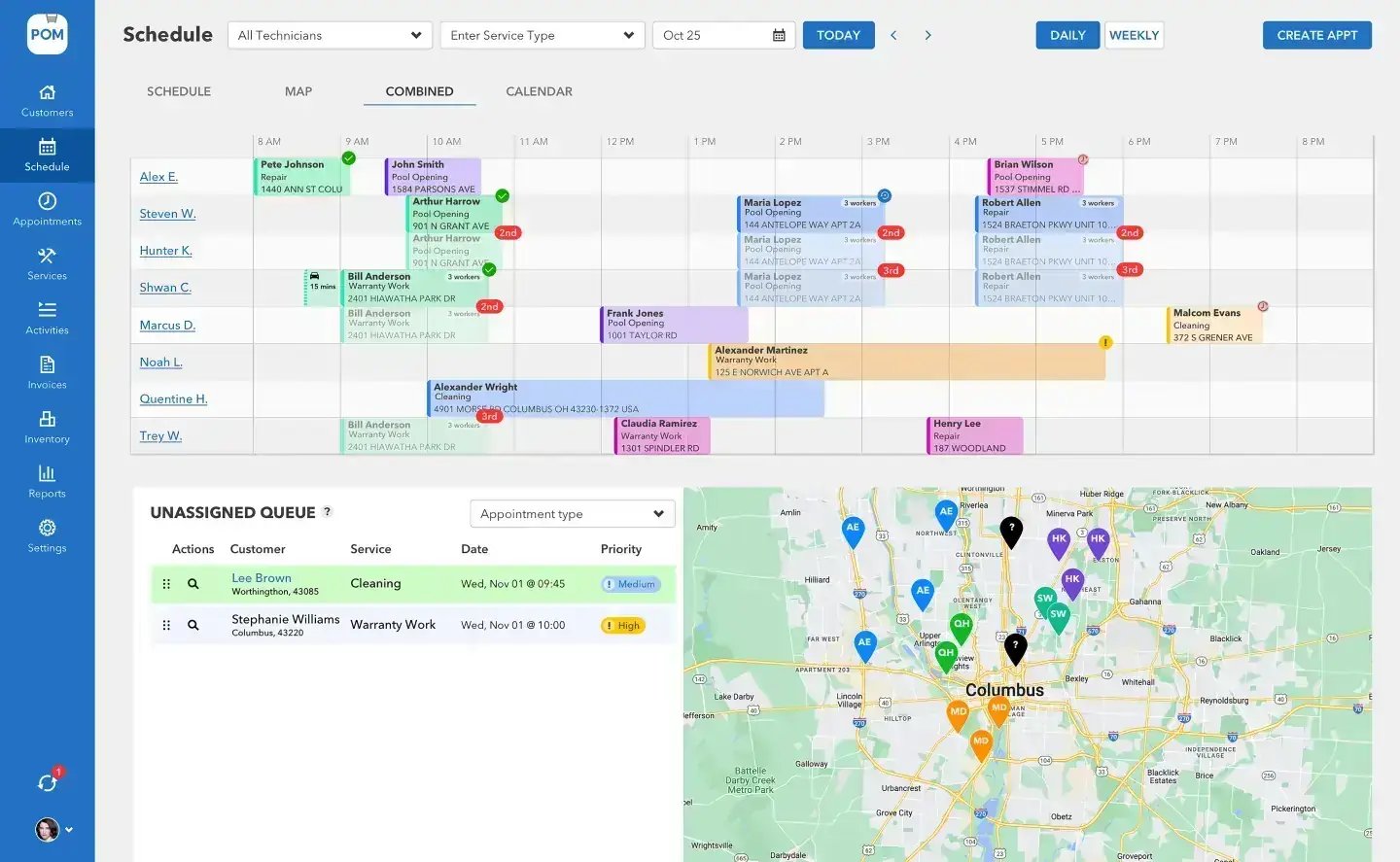
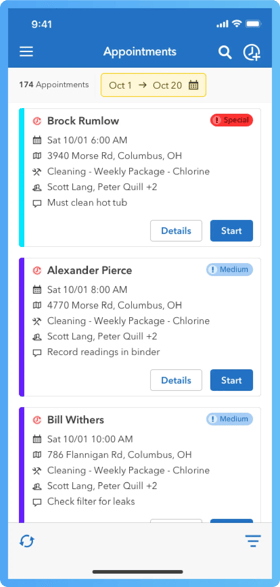
Techs log CYA with the rest of the readings, and the report shows the LSI next to them. The office sees the trend for each pool over time, and the usage reports show how much stabilized chlorine went into it.
When CYA is too high
Draining and refilling part of the water is the reliable fix. Replace a third of the water and CYA drops by about a third, so 120 ppm becomes roughly 80. Reverse-osmosis filtration also removes it, at a higher cost, and the water needs rebalancing afterward. Products and specialty filters that claim to remove CYA have a mixed record. After any of these, retest and rebalance calcium and alkalinity.
Then fix the cause. If stabilized chlorine put the CYA there, switching that pool to liquid chlorine or cal-hypo for part of the season keeps it from climbing back.
Sources and a note on this guide
The figures here follow Orenda Technologies’ article Understanding Cyanuric Acid, which is worth reading in full. This guide is general information for pool professionals. It does not replace product labels, your local health code or your own testing.
We were excited to try this program and have been satisfied with the use. Love the scheduling feature, from an office stand point, and the guys are happy with not having to use paper.
Town & Country
I can easily keep track of my employees progress throughout the day and have the ability to send other techs to fill in if needed. Love the maps optimization feature. Saves time and money
Aqua Clear Pools
Great software program. Keeps our route in order while providing detailed service reports to all of our clients when the cleaning/maintenance is complete
Blue Water Pools
FAQ
CYA questions
What is a good CYA level for a residential pool?
Orenda Technologies recommends 30 to 50 ppm. That is enough to protect chlorine from the sun without slowing it down much. Commercial pools should follow their health department’s limit.
Does CYA go away on its own?
Barely. It does not evaporate, and it breaks down very slowly. It leaves when water leaves: splash-out, backwashing, or a partial drain and refill.
Why does a pool with plenty of chlorine still turn green?
Often because CYA is high. Chlorine held by CYA works slowly, so the free chlorine reading can look fine while algae gets ahead. Compare free chlorine with CYA before adding more.
Does CYA change the alkalinity reading?
Yes. About a third of the CYA reading is counted in total alkalinity. Subtract it to find carbonate alkalinity, which is the number that matters for water balance.
Where do techs record CYA in POM?
On the service report, with the other chemistry readings. The office can see the reading on the report and the trend for that pool over time.
Track every reading on every visit
30-day free trial. Set up your readings and service reports this week. Questions: 614-710-0074.